The Modern Auto Repair Marketing Framework
A clear way to understand what works, why it works
& where effort belongs

I recently had a conversation with a marketing coach who has been around this industry a long time.
The kind of guy who has seen radio work, has seen newspaper ads work, and has seen shops grow for decades without ever worrying about Google, reviews, or social media.
At one point he said, “If I were a shop owner today, I would probably just stick with radio and a simple one page website. You know, KISS. That is what people understand.” I did not disagree with him. But I did not fully agree either. Because here is the part that gets missed in a lot of these conversations. Marketing did not stop working the old ways. Those ways just stopped working alone.
Nothing disappeared. Everything stacked. Radio still has value. So does word of mouth. So does being known in your town. But now those things sit alongside Google searches, online reviews, photos, videos, and the quiet ways customers check you out before they ever call or walk in. That layering is what makes marketing feel confusing and heavier than it used to. And it is why so many shop owners feel stretched, unsure where to focus, and frustrated when advice conflicts.
This framework is meant to change that. Not by telling you what to buy or what to chase, but by helping you understand how modern auto repair marketing actually works. By the end of this, you should be able to see why marketing feels heavier, understand what each type of marketing is responsible for, and make calmer, more intentional decisions about where your effort belongs.
Before getting into what to focus on now, it helps to understand how we got here. Not in a nostalgic way, and not to say things were better back then, but to see how marketing actually evolved over time. When you step back and look at it decade by decade, the confusion starts to make sense.
Here is where we start.
How Auto Repair Marketing Changed: 1975 to 2026
One of the biggest reasons marketing feels harder today is because most people are trying to evaluate it using an old measuring stick.
For a long time, marketing lived in a fairly simple world. There were fewer places customers looked and fewer signals they relied on to make a decision. If you showed up consistently in the places that mattered back then, it worked.
That does not mean those methods were better. It just means the environment was lighter. What changed is not that marketing stopped working. What changed is that it layered. Nothing disappeared. Everything began to stack.
In the 1970s, marketing was largely local and personal. Word of mouth carried enormous weight. Your physical location mattered. A recommendation from a neighbor or a trusted mechanic down the street was often enough for someone to make a decision.
By the mid 1990s, new layers were added. Yellow Pages became a major reference point. Radio started playing a stronger role. Early websites showed up, not as decision makers, but as credibility markers. You did not need much, just proof that you existed.
As search engines grew in the 2000s and early 2010s, another layer was added. Google became the starting point. Reviews entered the picture. Websites were no longer optional, they became part of how customers compared one shop to another.
Then came mobile search. People were no longer researching at home on a desktop. They were standing in parking lots, sitting in waiting rooms, or pulled over on the side of the road. Social proof started to matter more. Content, photos, and visible activity became part of how trust was built.
And now, we are entering the next layer.
Search still matters. Reviews still matter. But now AI summaries are pulling from reviews, websites, photos, community conversations, and consistency across platforms to form an opinion on behalf of the customer. That opinion is often formed before a shop ever knows the customer was looking.
This does not mean everything changed overnight. It means more signals are being gathered quietly, and faster.
Marketing Relevance Over Time: 1975 to 2026
- 1975 focused on word of mouth, newspaper, and physical location.
- 1995 added Yellow Pages, radio, and early websites.
- 2010 layered in Google search, reviews, and stronger website expectations.
- 2020 expanded into mobile search, social proof, and content.
- 2025 now includes Google plus Ai summaries, reviews with responses, visual trust, and consistency everywhere.
When you see it laid out this way, something important begins to click. Marketing did not get worse. It did get heavier because it got layered. Each decade added another place customers look. Another question they quietly ask. Another signal they use to decide whether a shop feels trustworthy and current. That is why marketing feels more complex today. Not because you are doing it wrong. Not because the old ways stopped working. But because they no longer work by themselves.
Once that reality is understood, the pressure eases. The goal stops being to do everything, and starts being to understand what role each piece plays. This understanding is what makes the rest of this framework useful.
Not All Marketing Does the Same Job
One of the most common frustrations I hear from shop owners is that marketing feels intangible. They cannot quite grab hold of it and make it “work.” Something works for a while, then it does not. One effort brings calls, another seems invisible, and it becomes hard to tell what to keep, what to fix, or what to stop.
A big part of that frustration comes from expecting every piece of marketing to do the same job. It does not. Every marketing effort serves a different purpose. When those roles are clear, results make sense. When they are not, everything feels inconsistent and disappointing.
This is where clarity starts to replace pressure.
Understanding Marketing Types and What Fits Where
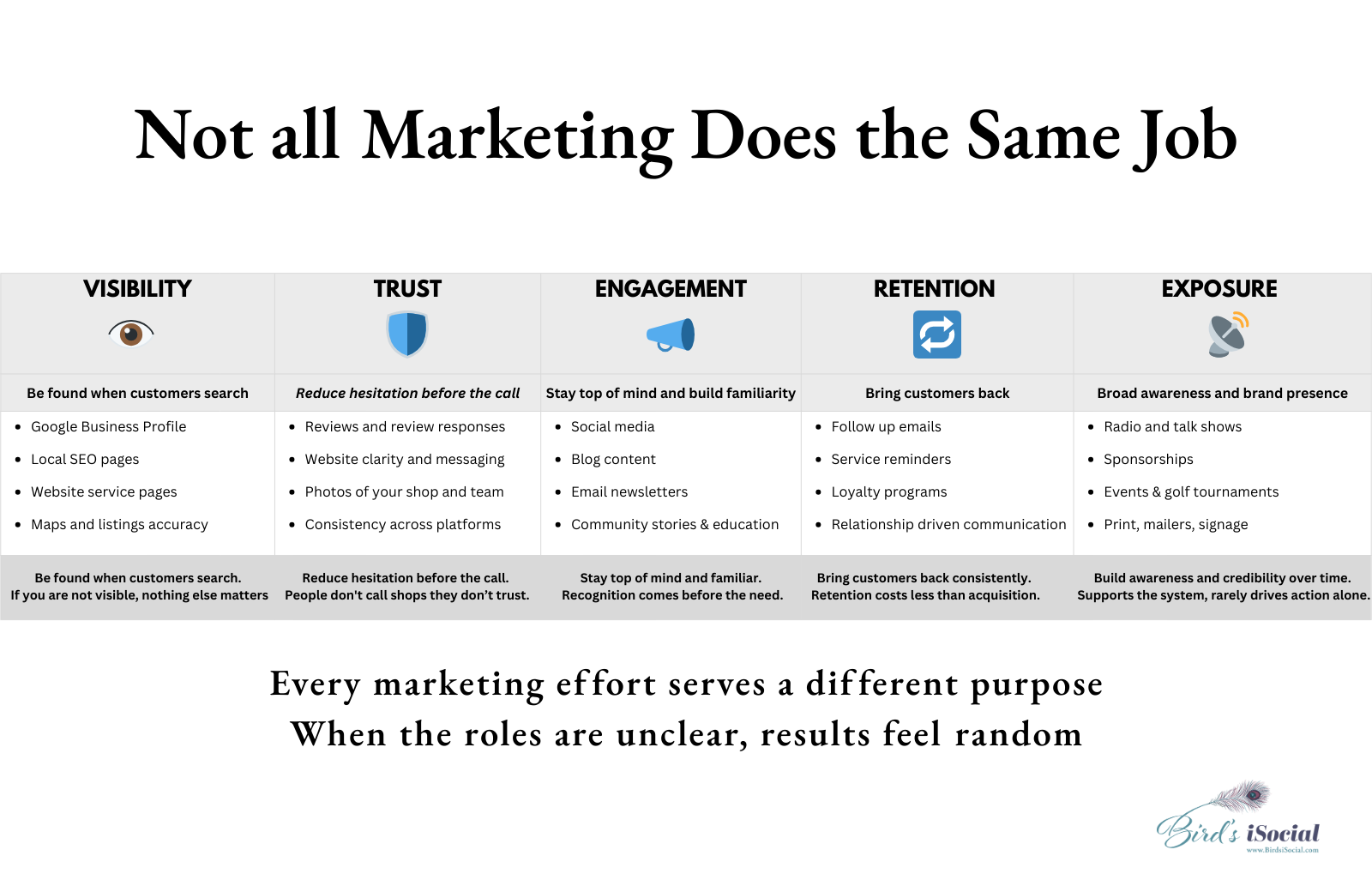
Think of marketing as five different types of work. Each one supports the others, but none of them can replace the rest.
Visibility
Visibility exists so customers can find you when they are actively looking. This is where your Google Business Profile, local SEO pages, website service pages, and accurate maps and listings live. The bigger the net, the more chances you have to be found. Every indexed page on your website gives Google another reason to show your shop. Visibility helps customers discover you at the exact moment they need service. If you are not visible, nothing else matters, because customers cannot choose what they cannot find.
Trust
Trust exists to reduce hesitation before the call. Reviews and review responses, clear website messaging, photos of your shop and team, and consistency across platforms all live here. Trust helps customers feel confident choosing you over the shop next door. People do not call shops they do not trust, even if those shops show up first.
Engagement
Engagement exists to keep your shop familiar before a customer needs you. Social media, blog content, email newsletters, and community stories all live in this category. Engagement does not usually drive immediate calls. What it does is build recognition, so when a need shows up later, your shop already feels known.
Retention
Retention exists to bring customers back. Follow-up emails, service reminders, loyalty programs, and relationship-driven communication live here. Retention turns one-time customers into long-term relationships. It is also one of the most overlooked areas of marketing, even though retention consistently costs less than acquisition.
Exposure
Exposure exists to build broad awareness and reinforce credibility over time. Radio shows, sponsorships, events, golf tournaments, print, mailers, and signage all live in this category. Exposure helps people recognize your name and associate it with the community. On its own, it rarely drives direct action. It works best when it supports the rest of the system.
Where frustration usually shows up is when one type of marketing is expected to do another type’s job. When radio is expected to drive immediate calls without visibility or trust. When social media is expected to replace search. When reviews are expected to compensate for being hard to find.
Understanding the role of each type leads to better decisions. Not louder ones. Better ones.
Modern Auto Repair Marketing
Budget and Attention Ratios for 2026
Once the roles of marketing are clear, the next question naturally follows. Where should effort actually go? This is where things often get tense, because budget conversations can feel personal. Shops have history with certain marketing avenues. Some things feel safe. Others feel unfamiliar. That is why this section is not about trends or opinions. It is about structure.
Not every marketing activity carries the same weight. Some things are foundational. Some are supportive. Some work best only after the basics are solid. When effort is spread evenly across everything, results feel thin. When effort is aligned with how customers actually find and choose shops today, results compound.

Budget and Attention Ratios for 2026
45%
At the base of the system is the foundation. Roughly forty five percent of marketing attention belongs here because these elements determine whether customers can find you at all. This includes your Google Business Profile, website service and location pages, review responses, listings accuracy across platforms, local SEO fundamentals, and readiness for Ai driven search. If these pieces are weak or inconsistent, everything built on top of them struggles to perform.
25%
The next layer is engagement and trust, which generally accounts for about twenty five percent of effort. This is where organic social media, blogs and educational content, short form video, email communication, and community storytelling live. These elements influence who calls and who feels confident choosing you. They do not usually create urgency, but they do create familiarity and reassurance, which matter more than most shops realize.
20%
Exposure and amplification typically make up about twenty percent of effort. This includes Google Ads, Facebook Ads, direct mail, seasonal promotions, and retargeting. These tools work best when they amplify something that already works. When foundation and trust are strong, paid efforts accelerate results. When they are not, paid efforts often feel expensive and frustrating.
10%
The final layer is awareness and authority, usually around ten percent. Radio talk shows, golf tournaments, community events, speaking, teaching, and local press live here. These activities reinforce credibility and keep your name present in the community. They are valuable, but they work best as reinforcement, not as the primary engine driving new customers.
The takeaway here is simple. Awareness works best when foundation and trust are already in place. When the base of the system is solid, every other effort becomes more effective and less stressful.
This structure is not meant to be rigid. It is meant to be grounding. It gives shop owners a way to evaluate decisions without reacting to the loudest voice in the room.
Data that informs this framework consistently points to the same conclusion. Local search behavior, review influence, trust in advertising, and retention economics all reinforce the importance of a strong foundation first. Sources such as BrightLocal, Google Consumer Insights, HubSpot, Nielsen, and Harvard Business Review all reflect this pattern in different ways.
When effort is aligned with structure, marketing stops feeling scattered. It starts feeling intentional.
How Customers Actually Decide
One of the reasons isolated marketing tactics feel disappointing is because customers do not make decisions in isolation. They move through a sequence, often without realizing it. And when marketing mirrors this sequence, it works. When it does not, things feel disjointed.
This is not a funnel in the traditional sense. It is not linear or perfect. It is a pattern that shows up again and again in how people choose where to take their car.
The Real Marketing Decision Flow
Most decisions start with a search. Customers look on Google. They check Maps. Increasingly, they see Ai summaries that pull from reviews, websites, photos, and community conversations. This is the moment where visibility matters. If a shop does not show up here, the rest of the process never happens.
Once a shop appears, the next step is trust. Customers read reviews. They scan photos. They notice whether information is consistent across platforms. They look for signs that the business feels current, real, and aligned with what they expect. This is where hesitation is either reduced or reinforced.
If trust feels solid, the customer moves to action. They call or click. At that point, website clarity and the phone experience matter more than most shops realize. Confusing messaging, outdated information, or a rushed interaction can undo everything that came before.
Next comes the visit. The in shop experience, the culture, and how well expectations are met all come into play. This is where marketing and operations intersect. What was promised online needs to match what happens in person.
Finally, there is the return. Follow up communication, service reminders, and reputation reinforcement determine whether a one time visit becomes an ongoing relationship. This is where retention quietly does its work.
The takeaway here is simple. Marketing works best when it mirrors how customers actually decide. When each step supports the next, the system feels natural. When one piece is missing or misaligned, the whole experience feels off.
That is why integrated marketing matters. Not because it is trendy, but because it reflects real behavior.
Turning Clarity Into Calm Decisions
Most shop owners do not fail at marketing. They get stuck trying to do everything at once without knowing what actually matters first. When marketing feels stressful, it is usually because it has become reactive. Something changes, advice comes in from multiple directions, and decisions start stacking on top of each other without a clear center. Over time, that creates pressure instead of progress.
Marketing becomes sustainable when it is intentional
That is what this framework is meant to support. It is not about doing more. It is about knowing what matters now, knowing what can wait, and knowing what supports what. When marketing is aligned this way, effort compounds instead of competing for attention. Strong shops tend to focus on a few fundamentals before chasing new leads. They make sure customers can find them. They make sure customers trust what they see. They make sure customers understand who they are and what they stand for. Once those pieces are solid, everything else works better.
This is an important reframe
Marketing is not a pile of tactics. It is a system. And that system should reflect how you serve customers, how you run your shop, and how you want to be known in your community. When marketing mirrors reality, trust grows naturally without forcing it. You do not need to overhaul everything. You need clarity, consistency, and the right next step. That step looks different for every shop, depending on where they are and what they want to protect or grow. And that is okay.
If you ever want a second set of eyes to talk through where you are and what matters most next, that conversation should feel calm, honest, and useful. That is how good decisions start.
Sources and Data Notes
This framework is informed by a combination of industry research, consumer behavior studies, and real world observation across independent auto repair shops.
Primary sources referenced include:
Google Consumer Search Behavior
https://www.thinkwithgoogle.com/consumer-insights/local-search-behavior/
BrightLocal Local Consumer Review Survey
https://www.brightlocal.com/research/local-consumer-review-survey/
HubSpot Marketing ROI and Benchmark Reports
https://www.hubspot.com/marketing-statistics
WordStream Local Advertising Benchmarks
https://www.wordstream.com/blog/ws/local-advertising-statistics
Nielsen Trust in Advertising
https://www.nielsen.com/insights/2021/the-truth-about-trust/
For simplicity & clarity, infographic data is summarized and informed by research from BrightLocal, Google Consumer Insights, HubSpot, Nielsen, and Harvard Business Review, particularly around local search behavior, trust signals, media effectiveness, and retention versus acquisition cost.